The Riff That Didn’t Ask to Be a Song: Notes from a Shared Band Folder
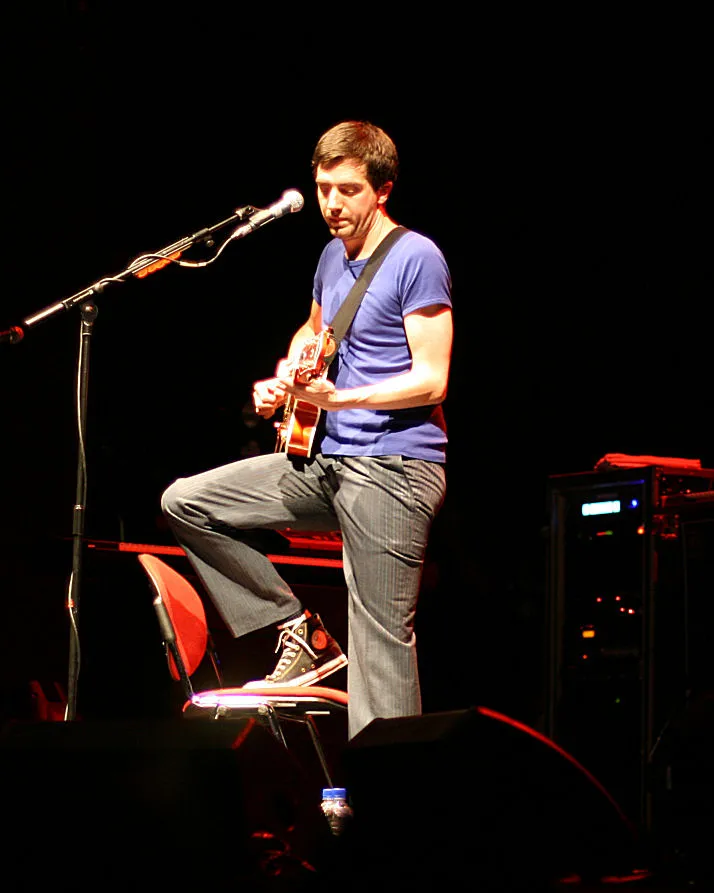
Photo: Photographer: Jacqui Sadler, United Kingdom, CC BY-SA 2.0, via Wikimedia Commons
There is a folder on every band’s shared drive that nobody opens unless the conversation has run dry. It has a name like ‘NEW IDEAS’ or ‘riffs’ or, more honestly, ‘stuff’. Inside: forty-seven voice notes, a handful of grainy videos, three GarageBand files that will not open on anyone’s current laptop, and one recording of a riff played on a detuned acoustic in a stairwell at 1am. It is the half-song graveyard. And most of us treat it like a confession rather than an archive.
The scene is familiar. Rehearsal room above a carpet shop in Leeds, Tuesday night, kettle on. Someone says, ‘What about that thing from the spring?’ Everyone nods. Someone scrolls. The riff comes out of a phone speaker, thin and tinny, and for thirty seconds it sounds like the best idea the band has ever had. Then you try to play it together and it collapses into a verse that goes nowhere, a chorus that arrives too early, and a middle eight that sounds like a different band arguing in a corridor. You shelve it again. You call it unfinished. But what if it was never meant to be finished in the first place?
The guilt of the unfinished
Guitar bands are taught to think in completed songs. A riff is a seed; a song is the harvest. Anything less is a failure of application, a lack of discipline, a sign that you were noodling rather than writing. That story is useful if you are in a band that needs to finish twelve songs for a record. It is less useful if you are three people in a small room trying to work out what you actually sound like.
The truth is that most riffs arrive without a job description. Some are intros. Some are outros. Some are the bit between the second chorus and the last chorus that nobody can name but everyone feels. Some are warm-ups that sound terrible on record and brilliant at 8:15pm when the amps have finally warmed up and the room has stopped smelling of damp. Some are just a way of getting the fingers moving while the singer finds the capo. None of those are failures. They are simply ideas that have not been asked the right question.
The half-song graveyard is not a graveyard. It is a parts department.
A riff is not a contract
Here is the freeing thing: an idea does not owe you a song. A two-bar phrase can live its whole life as a soundcheck loop, a bridge between two louder songs, or a thing you play when the headline act is late and the crowd needs something to look at. In 2026, with grassroots gigs operating on tight turnarounds and small rooms that reward atmosphere over polish, a fragment can be a useful piece of kit. It can be a mood setter. It can be a palate cleanser. It can be the ten seconds before the drummer counts in that makes the room lean forward.
That does not mean every scrap deserves a stage. It means the question ‘Is this a song?’ is often the wrong one. Better questions: Does this riff make us play better? Does it change the temperature of a set? Does it belong to another song we already have? Could it be a B-side, an interlude, a hidden track, a warm-up, a bridge? Some ideas are not failed songs. They are future transitions that have not met their neighbours yet.
The archive as a warm-up ritual
A useful archive is not a museum. It is a practice tool. The bands that get the most out of their stray ideas tend to do three unglamorous things.
First, they listen without writing. Once a month, twenty minutes, no instruments. Just the folder. No pressure to finish anything. The goal is familiarity, not productivity. You are reminding yourself what is in the cupboard.
Second, they name things properly. ‘New idea 3’ tells you nothing. ‘DADGAD, slow, sounds like rain on a skip’ tells you something. Add key, tempo, feel, and the date. A simple spreadsheet is enough. The point is not admin for its own sake. The point is that future-you can find the thing without scrolling through four years of voice notes and losing the will to live.
Third, they keep a ‘bridge bank’. Any part that feels like a bridge, a break, a link or a lift gets parked in one place. When a new song stalls before the last chorus, you go to the bridge bank first. Often the answer is already there, recorded on a phone in a different room, waiting to be promoted.
What to do with a maybe
When you revisit the folder, resist the urge to force a full arrangement. Instead, sort each idea into one of three piles: promote, park, or plunder.
Promote means it is ready for rehearsal. Give it a working title, a tempo, and a job. Park means it is interesting but not now. Set a date six months ahead and leave it alone. Plunder means it contains one good part — a chord change, a turnaround, a rhythm — that belongs somewhere else. Take the part, thank the fragment, and let the rest go.
There is also a fourth option that UK bands sometimes forget: let it be a warm-up. Some riffs are excellent at loosening the wrists and terrible at holding a song together. That is fine. Play it at the start of practice, then put it away. It has done its job.
Letting a fragment stay a fragment
The half-song graveyard is only a problem if you believe every idea must graduate. Some riffs are weather. They mark a time, a place, a version of the band that no longer exists. The one recorded in the stairwell after a gig in Bristol. The one that sounds like the 23:12 train home. The one that only works when the room is cold and the amp is borrowed. You do not have to turn those into choruses. You can keep them as evidence that you were listening.
So open the folder. Not to finish everything. Not to prove you are productive. Open it to see what is actually there. Somewhere in the forty-seven voice notes is a bridge you forgot, a warm-up you need, or a B-side waiting for a rainy Tuesday in 2026. The graveyard was never the problem. The problem was the eulogy.