The Long Way Round: Why Patient Guitar Songs Still Work in Small UK Rooms

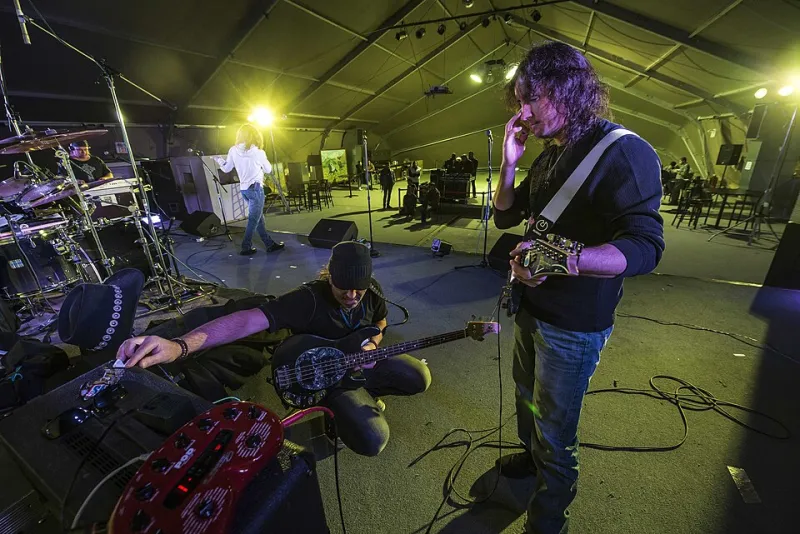
Photo: Judgefloro, CC0, via Wikimedia Commons
There is a moment, about four minutes into a six-minute guitar song, when a small room decides what kind of night it is going to be. Some people lean in. Some check their phones. The band keeps playing. In 2026, that moment is happening more often in UK underground venues, and it is worth asking why.
For years, the received wisdom was that songs should get to the point. Three minutes, maybe three and a half. Verse, chorus, bridge, out. Streaming rewards the quick hook. Radio likes the tidy edit. A support slot is twenty-five minutes, so why spend a fifth of it on one song?
But guitar bands have never been very good at received wisdom. Across small rooms in Leeds, Glasgow, Bristol, Sheffield and London, long songs are creeping back into sets. Not as a nostalgia trip, and not as a test of endurance. More as a way of letting a riff, a groove or a mood take up the space it needs. The six-minute track is returning quietly, one patient audience at a time.
Three Minutes Is a Format, Not a Law
A three-minute song is a useful container. It is not a moral position. Plenty of great guitar music has been made in under three minutes, and plenty of terrible music has been made in six. Length is not a virtue on its own.
But somewhere along the way, short became the default and long became suspicious. If a song stretched past five minutes, it was indulgent. If it had a slow intro, it was a self-edit waiting to happen. That attitude made sense for radio programmers and playlist editors. It makes less sense in a room where people have paid a fiver on the door and are standing close enough to see the guitarist's fingers.
A six-minute song is not automatically ambitious. Sometimes it is two three-minute ideas refusing to separate. But when a band uses the extra time properly, the length becomes part of the song's tone. It gives the audience room to settle into a groove, to notice the small changes, to feel the moment when the whole thing opens up.
The Room Is Part of the Arrangement
Small UK venues are not neutral spaces. They have low ceilings, odd corners, sticky floors and their own natural reverb. A long song has to account for all of it. The room is the final stage of the signal chain, after the amp, the pedals and the PA.
A slow intro is a tone problem as much as a songwriting one. If the clean guitar is too bright and the vocal is too quiet, ninety seconds feels like a soundcheck. If the amp is compressed in the right way and the reverb tail is doing some of the work, the same ninety seconds can feel like a world opening up. The difference is not always more gear. Sometimes it is less: fewer pedals, more space, a guitarist who trusts a single note to ring out.
Dynamics matter more in a long song. A quiet section has to be genuinely quiet, and a loud section has to feel like a release rather than a continuation. In a small room, the audience is close enough to hear the difference between a band that is building something and a band that is just waiting for the next part.
Where Long Songs Belong in a Support Slot
If you are first on at 8pm to a room of people who came for the headliner, a six-minute opener is a big ask. It is not impossible, but it is a request for trust. Earn it with a shorter song first. Show the room what you sound like in three minutes, then ask them to come with you for six.
A long song can be a centrepiece, not a warm-up. Put it after two or three shorter tracks, when the room has stopped talking and started looking. In a twenty-five-minute support slot, one long song is usually enough. If it is instrumental, or if the band has a hypnotic groove, two might work. But a set of long songs in a support slot is a set that assumes a level of attention the room may not have agreed to yet.
There is also the question of the closer. A long final song can be a great way to leave a room in a certain mood, but only if it builds to something. If it just repeats until it stops, the audience will remember the stopping more than the song. The best long closers feel inevitable. They do not feel like the band forgot how to end.
Repetition Is Not Laziness
Repetition-heavy outros get a bad reputation, often for good reason. There is a fine line between a hypnotic groove and a band running out of ideas. The difference between trance and tedium is usually arrangement, not length.
A good long outro changes something. One instrument drops out. The vocal comes back with a different phrase. The drummer moves from the ride to the floor tom. The guitar stops soloing and starts holding a note. The audience needs a reason to stay inside the repetition, and that reason is usually a small, deliberate shift rather than a big new section.
This is where gear and tone meet songwriting. A delay set to self-oscillate is not a structure. A wall of reverb is not a chorus. The pedals should serve the shape of the song, not replace it. When a long track works, you can usually hum the riff after one listen and still notice something new on the second.
The Audience as the Final Pedal
A patient audience is still the best effect pedal a band can ask for. It is not something you can buy, and it is not something you can fake. When a room leans in, the band plays differently. The guitarist leaves a bit more space. The drummer holds back. The singer stops filling every gap with a nervous joke.
When a room talks, the opposite happens. The band turns up. The gaps get filled. The long song becomes a fight for attention, and the attention usually loses. That is why long songs survive best in grassroots rooms with a bit of trust in the air. The audience does not have to be silent. It just has to be willing to go along with it.
Bands can help that along. Do not apologise for the long song. If you introduce it with 'sorry, this one's a bit long', you have already told the room not to bother. Commit to it. Let the intro breathe. Do not rush the ending. The audience can feel the difference between a band that believes in the song and a band that is waiting for permission to stop.
Make It Earn Its Length
At Lost in Thought, we are not arguing for bloated sets or solos that go nowhere. We are arguing for songs that are allowed to be the size they need to be. A long track has to earn its time.
Does the intro do actual work, or is it just a countdown? Does each section change the picture? Is there a moment where something drops out and the room has to lean in? Does the ending feel like an arrival rather than a retreat? Would cutting a minute make it better? If the answer is yes, cut the minute.
Length should be a consequence of ideas, not a substitute for them. When a guitar band gets that right, a six-minute song in a small UK room can feel shorter than a three-minute song played by a band that is only going through the motions. The long way round is not for everyone. But in the right room, with the right audience, it still gets you somewhere worth going.