The Volume Knob Is a Social Instrument: Rethinking Loud in Small UK Rooms
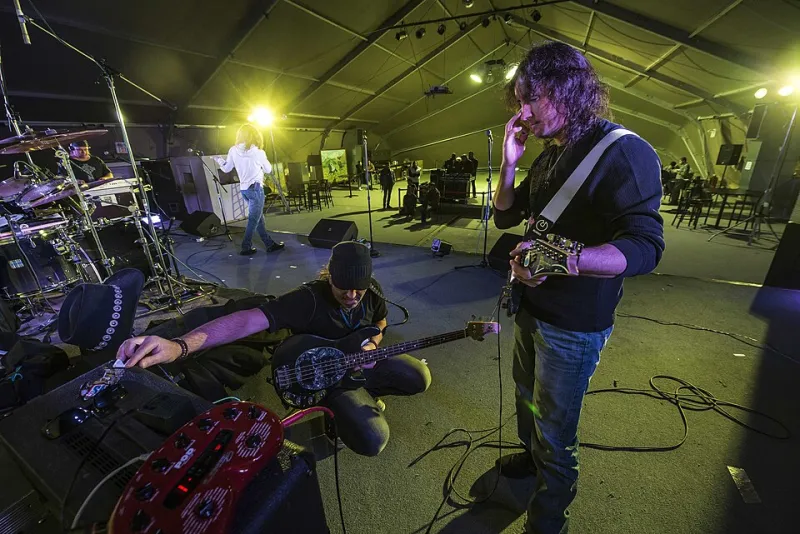
Photo: Senior Airman George Goslin, Public domain, via Wikimedia Commons
There is a familiar scene in small UK venues. A guitarist has just got their amp to the sweet spot — the point where the clean channel starts to breathe and the pedals stop sounding like toys — when a fretful promoter or sound engineer leans in and says the words every guitar band dreads: 'Any chance you could turn down?' The guitarist looks at the volume knob. It is already on two. The engineer points at the amp, not the master. The negotiation begins.
This is the quiet amp war, and it is being fought in back rooms, pub function rooms, arts centres and converted warehouses across the country. It is not really a war about volume. It is a war about space, compromise and what a guitar band is supposed to sound like in a room that was never designed for it.
The Room Always Has a Vote
Small rooms are not neutral. They have low ceilings, hard walls, soft furnishings that swallow highs and corners that turn bass into a fog. An amp that sounds enormous at rehearsal can become a shapeless mess at a 120-cap venue. The sound engineer is not being difficult when they ask for less stage volume; they are usually trying to make the band sound better. The promoter is not being timid when they pass on a noise complaint; they are trying to keep the venue open for the next six months.
In 2026, the pressures on grassroots venues have not gone away. Licensing, neighbours, environmental health and the simple economics of keeping a small room open all feed into the volume conversation. Bands used to letting amps breathe are being asked to think socially about sound. That can feel like an attack on the music. Often, it is the opposite.
What 'Turn It Down' Actually Means
Turning down is rarely just a matter of moving one knob. It might mean tilting the amp towards the guitarist's ears rather than the audience's knees. It might mean using a lower-wattage combo, an attenuator, or a pedal platform that gives the same feel at a lower volume. It might mean asking the drummer to play with a lighter touch — or accepting that the drummer is the loudest thing in the room and the guitar has to find its place around them.
The engineers I have spoken to tend to say the same thing: a quieter stage often gives them more control. If the amps are not flooding the room, the front-of-house mix can breathe. Vocals stop fighting. The kick drum and bass can occupy their own space. The guitar might actually sound louder to the audience because it is clearer, not because it is pushing more air.
That is the paradox at the heart of the quiet amp debate. Lower stage volume can sharpen dynamics rather than flatten them. If the band starts at a reasonable level, the loud chorus has somewhere to go. If everything is at maximum from the first bar, the only direction is sideways.
Dynamics Versus the Wall of Sound
There is a legitimate case for volume. Guitar music is physical. A loud amp moves air, interacts with the room and can produce feedback that feels like part of the song. Some bands need volume to get the sustain and compression they want. Shoegaze without volume can sound thin. Doom without low end can sound like a polite rumble. Post-punk can be sharp and lean, but it still needs bite.
The problem is that volume is often used as a substitute for arrangement. If every instrument is loud all the time, the audience stops hearing the details. The wall of sound becomes a wall, and walls are hard to listen through. The bands that manage this best are the ones that think about contrast. They let a verse sit low so the chorus can hit. They use silence and space as part of the tone. They treat the volume knob as an instrument, not a default setting.
The Promoter's Dilemma
Promoters are caught in the middle. They want the band to sound good, the audience to have a good time and the venue to survive. A noise complaint can lead to a licence review, a fine or a lost gig. Nervous promoters sometimes ask for volume levels that are too low, and that can flatten a night. But the answer is not to ignore them. It is to talk before the doors open.
Good promoters and engineers will tell you what the room can take and why. Good bands will ask what the actual limit is rather than assuming it is an attack on their identity. The conversation is usually more productive when everyone admits that the room has a vote. The best small gigs are not the ones where the band wins the volume argument. They are the ones where the band, the engineer and the promoter find a level that lets the music do its job.
A Different Kind of Heavy
Heavy is not only a measurement. Some of the heaviest guitar bands I have seen in small rooms have not been the loudest. They have been the ones with a clear midrange, a drummer who does not need to fight the amps, and a singer who can be heard without screaming. The weight comes from the attack, the timing and the tone. It comes from the band listening to each other rather than trying to fill every inch of air.
That does not mean every band should become quiet. It means the quiet amp war is not a simple binary. There is a difference between turning down to please a nervous promoter and turning down to make the music land harder. The first is a compromise. The second is a craft decision.
The Knob as a Social Contract
In the end, the volume knob is a social instrument. It governs how the band relates to the room, the audience, the staff and the neighbours. It also governs how the band relates to itself. When the amps are not overwhelming everything, the players have to listen more closely. They have to trust the drummer, the bass and the space between the notes.
For a guitar-led underground in 2026, that might be the most radical thing of all: not the ability to be loud, but the ability to choose when to be loud. The quiet amp war will keep rumbling in small UK rooms. The bands that survive it will be the ones that realise turning down is not always about getting smaller. Sometimes it is about letting the songs get bigger.