The Shift Before the Set: How Day Jobs Write Themselves Into Guitar Songs

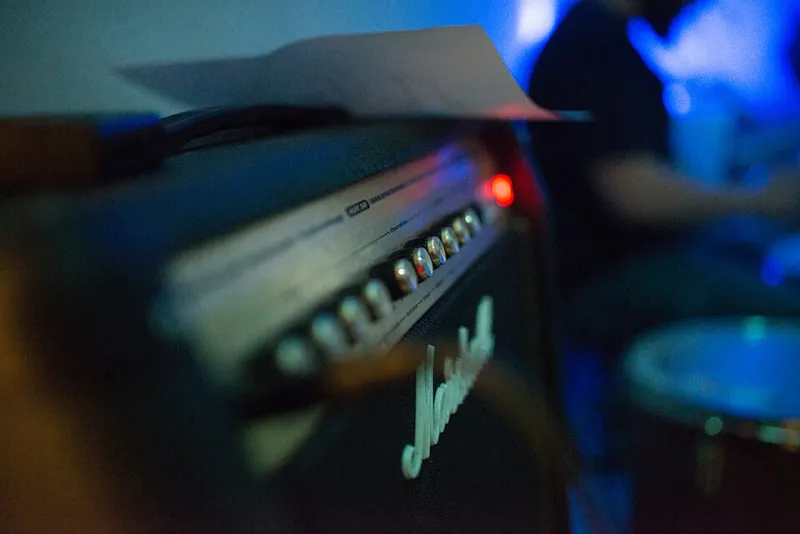
Photo: Electra Roberts, CC BY-SA 4.0, via Wikimedia Commons
It's ten past seven on a Tuesday and the rehearsal room in Leeds smells of radiator dust and someone else's energy drink. Salt Flats have the room until nine. Two of them came straight from work; one is still in a polo shirt with a lanyard tucked into the collar so it doesn't swing into the strings. They spend the first eight minutes not playing at all — swapping leads, arguing mildly about the set order, and eating a bag of crisps with the urgency of people who haven't sat down since noon.
This is what the UK underground actually sounds like. Not a wine bar and a launch party, but a borrowed room, a clock on the wall, and a hard stop before the last bus.
The Rehearsal Slot Is a Diary Problem
Ask any grassroots band what limits them and you'll hear the same three words: time, money, time. Salt Flats' drummer works early shifts at a distribution centre in Stourton; their guitarist does four on, four off at a hospital. That rota, not artistic temperament, decides when the band exists. The result is a two-hour window every other Thursday, which is roughly the same amount of contact time as a school football team.
What surprised me is how little they mourn it. 'You stop waiting for the perfect session,' says El, who sings and plays. 'You turn up with the song already decided. You don't spend forty minutes finding a tone. You find the tone at home with headphones and you bring it in like a packed lunch.'
The constraint has bred a certain ruthlessness. Nothing gets rehearsed that hasn't already been demoed at home on a phone. Nothing gets a second run-through unless someone can say why. Between songs they talk in shorthand — bars, not paragraphs.
Songs Written Between Stops
Bramble Court, a Bristol three-piece, wrote most of their last EP on public transport. Their bassist commutes from Yate; their guitarist does a Temple Meads to Parkway hop that's just long enough to hum into a voice memo without feeling self-conscious.
'You get these eight-minute windows where there's nothing to do but think in melody,' she tells me. 'Half our riffs started as something I was too embarrassed to sing out loud on the 07:12. By the time I got to the room, the band had already filled in the rest.'
There's a practical consequence to writing this way: the songs tend to be compact. You don't sketch a six-minute odyssey into a phone on a crowded platform. You sketch a hook, a turn, a two-minute idea that either survives contact with the full band or quietly dies. Bramble Court's set has tightened by about ten minutes in a year, and they're better for it. Short, punchy, and — crucially — rehearsable on a Thursday.
What Limited Time Does to Arrangement
Nine Volt Sunday, from Glasgow, have a rule that borders on superstition: if a part can't be taught in the room in under five minutes, it doesn't go in. Their guitarist calls it the last-bus test.
'It's not laziness,' he says. 'It's editing by circumstance. You cut the third guitar layer because there's no third guitarist and no time to teach one. So the song has to work with two. And it does. It works better, because everybody's playing something they actually understand.'
This is the quiet gift of the day job. When your hours in a room are precious, arrangement becomes a process of subtraction. Parts that existed only because someone had an idea at 2am don't survive. What's left is the skeleton, and skeletons are loud.
Saying No Is a Creative Act
All three bands mentioned the same thing unprompted: they turn down more gigs than they play. Not out of coolness, but because a Wednesday night in a city three hours away means a half-day of annual leave, a favour from a colleague, and a Thursday spent working on four hours of sleep.
The scene has adapted. Promoters in Leeds and Bristol have started stacking grassroots nights onto Fridays and Saturdays not out of glamour but because that's when the workforce is free. It's a small, unglamorous piece of infrastructure that nobody writes about, and it decides which bands get heard.
'There's a weird idea that turning something down makes you less committed,' says Bramble Court's drummer. 'It makes you more. You're protecting the thing. If I play badly because I've been on my feet for eleven hours, that's not dedication, that's just a bad gig.'
Stamina, Not Romance
There's a romantic version of the underground where nobody has a job and everyone is free and the art flows. It doesn't match the rooms I've stood in. What I've seen instead is stamina: people who load a car after a shift, play a twenty-five-minute set with real focus, and then talk about the mix in the smoking area with the specific clarity of someone who has to be up at six.
That clarity is the point. The day job doesn't dilute the sound. It gives it a shape — short songs, deliberate arrangements, sets that don't outstay their welcome, and a band that plays like every minute in the room is a minute they fought for.
Clock in, tune up. That's the whole thing, really.