Learning to Lean Into the Howl: A Guitarist's Guide to Feedback in Tight Rooms
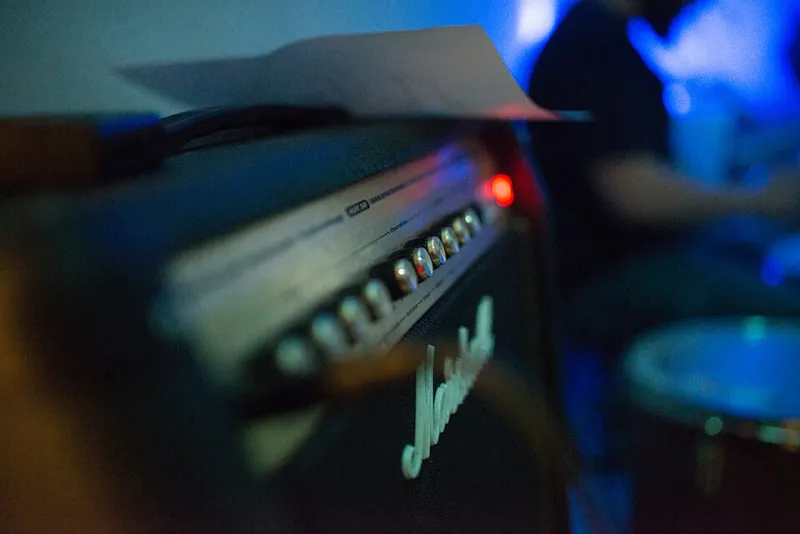
Photo: Shixart1985, CC BY 2.0, via Wikimedia Commons
There's a particular face a guitarist makes at the exact moment of an unprompted howl. It's half shame, half trespass — the look of someone whose phone has gone off in a quiet carriage. They reach for the volume knob, mouth an apology at the singer, and spend the next two songs playing six inches from the amp, terrified.
Let's retire the face. In a grassroots room, feedback is not an accident of an amateur. It's an acoustic fact. The guitar is a microphone with strings on it, the amp is a speaker, and the room is a third band member who turns up unannounced and plays whatever it likes.
Why It Happens, Briefly
You don't need a physics lecture, just a mental model. Any sound system that takes a signal from a pickup, pushes it through a speaker and back into a pickup will eventually feed itself if the gain is high enough and the geometry is unlucky. The frequency that howls is the one the room likes best: a standing wave, a resonance, whatever frequency has the shortest, friendliest path from speaker to pickup.
Small rooms are feedback factories for a simple reason — the walls are close. There's less distance for the sound to travel and less space for it to dissipate. A back room above a pub with a low ceiling, hard plaster and a corner stage is effectively a feedback chamber that sells pints.
Hollow-body guitars, acoustic guitars, and single-coil pickups are all more prone to it. So is any guitarist who stands directly in front of their own cab, facing it, which — let's be fair — is most of us for at least the first three songs.
Five-Minute Tests Before Doors
You have twenty minutes of soundcheck, and if there are three bands, roughly six of them. Use the time like a test rather than a performance.
- The walk test. Play a steady open chord and slowly walk the length of the stage. Find the spots where the guitar starts to bloom into a howl. Remember them. That's your new geography — every song you'll gravitate to the safe zones without thinking about it.
- The turn test. Stand where you'd normally stand and rotate forty-five degrees. Then ninety. Half of all small-room feedback is solved by where your pickups point, not by turning down.
- The knob sweep. Find the frequency with the tone or a parametric EQ if you have one. Most small-room squeals live up around 2 to 4 kHz on a distorted guitar and lower on an acoustic. Cut a notch and listen for a couple of seconds to confirm — the magic of a narrow scoop is that most people in the room won't notice, while you gain headroom.
- The gain-and-a-half test. Do not set your stage volume in the soundcheck and then boost your pedal in the first chorus. Set your dirt channel as loud and as bright as it will get, then test. If it survives the loudest moment, it survives everything.
Monitors Without Monitors
Grassroots rooms often have one vocal monitor, or none, or one that buzzes. The instinct is to turn the guitar up to hear yourself. That is exactly the wrong move in a small space: if you can't hear yourself, it's usually because the room is full of you.
Tilt the amp. Angling a combo back towards your head gives you clarity at lower volume, and stops the beam of sound shooting at the front row and bouncing back into your strings. A tilted amp at 3 is louder to the person playing than a flat amp at 6.
Get your cab off the floor and out of the corner. Corners amplify bass and bounce treble. Even twenty centimetres of feet away from a wall changes the picture.
Use the body. If you must play quiet, don't just turn the volume down; turn the gain up a little and the volume down more. Saturated and quiet behaves far better than clean and loud in a reverberant box.
Watch the singer's mic. Many an apparent guitar squeal is the vocal mic picking up the guitar cab through the wedges. If the howl stops when you mute your pedal but not when you turn the amp down, it's the PA.
Make the Squeal a Member
Now the fun part. Feedback that arrives on cue is a texture. Enough records have used it as a drone, a pre-chorus swell, or a full stop that it's practically a genre convention by now. If the room wants to sing, let it.
Three approaches worth trying:
- The tail-hold. End a song on a chord, turn towards the amp, and let the pickup hold the note until it tips into a squeal. Control it with a volume pedal rather than your hand — you want the swell, not a switch.
- The tuning-by-feedback trick. Hold the guitar at a fixed distance and find the harmonic where the room rings cleanly. Some nights the room insists on a note. Use the note it offers.
- The pause. A single intentional howl between two songs, held for eight seconds, then silence. It resets the room. Audiences read deliberate noise as confidence, and confident silence as a much better gig.
Rehearse the Squeal
You can't do any of that if the first feedback of the night happens in front of strangers. Add five minutes at the end of rehearsal: turn the amp to gig volume, stand where you stand at gigs, and deliberately provoke a howl. Learn how far you can go before it takes over, and how quickly a small movement of the guitar brings it back under control.
What you're building is not a trick. It's a reflex — so that when it happens on a Saturday, your hand goes to a place that makes it a musical decision rather than a mistake.
When to Just Turn Down
Sometimes the room has no sense of humour. A tiny cellar, a low ceiling, a hollow-body, and a singer who needs to be heard: there is no heroic answer. Turn the amp down, tilt it, cut the offending frequency, and let the PA do the work. Giving up a bit of volume for a room that can hear the voice is not a defeat. The guitar is the reason most of us are here, but the song is why anyone came.
The room is always playing with you. You might as well play with it back.