The Pick Jar Doesn’t Lie: A Small Archive of Borrowed Songs
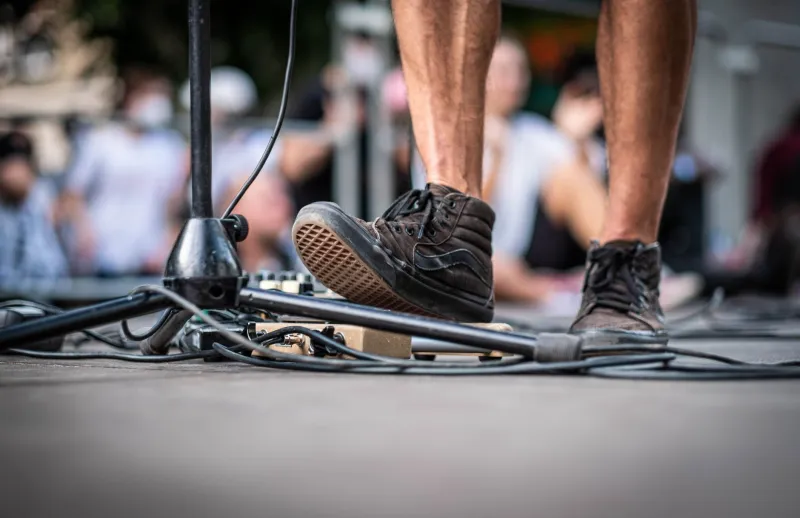
Photo: MOKZHUNG LEONIXMA, CC0, via Wikimedia Commons
There is a jar by the door in a lot of small UK venues. Sometimes it is a jam jar. Sometimes it is an old coffee tin, a pint glass with a paper label, or a Tupperware tub that has lost its lid. It is rarely labelled. It does not need to be. Everyone who has ever broken a string twenty minutes before doors knows what it is for.
The pick jar is not merch. It is not a monument. It is a small, grubby common treasury, and it tells you more about a grassroots guitar scene than any line-up poster ever could.
Lost Property, Found Again
Look inside and you get a cross-section of the room. A Dunlop Tortex 0.88 worn down on one corner. A flimsy neon 0.60 that came free with a string pack in 2019 and has somehow outlived three bands. A homemade pick cut from an old bank card, edges still sharp. A brass thing someone’s uncle made. A single, mysterious felt pick that nobody will claim.
Door staff see the jar at its most functional. ‘People ask if we’ve got a spare pick,’ one volunteer at a Sheffield music room told me. ‘I point at the jar. They take one. Nobody asks where it came from. Nobody ever puts it back.’ That last bit is not quite true. Some do. But the jar is not a lending library with a ledger. It is closer to a plectrum-shaped lost property box that has learned to keep itself stocked.
The economics are tiny and real. A pick costs 50p, maybe a pound if you are fussy. But at 7pm on a wet Tuesday, with the first band already loading in and the support act’s guitarist gripping a broken nail, 50p is not the point. The point is that someone in the room has a spare, and the jar is where the spare lives.
The Chipped Corner as a Diary
A used pick is a strange little document. The wear on the tip tells you how hard someone strums. The bend in the middle tells you they were nervous. The teeth marks tell you they were hungry, or thinking, or both. A pick that has been sanded down to a nub has probably played the same three songs forty times in a practice room with no windows.
One sound engineer I spoke to keeps a stash in the desk, not out of sentiment but out of self-interest. ‘A pick can save a changeover,’ they said. ‘If a guitarist drops their last one and the spare is in the jar by the door, that is two minutes saved. Two minutes is a lot when you have four bands and a curfew.’ The jar is not just generosity. It is logistics.
It is also an archive of near-misses. The pick that was borrowed for one song because the original was lost under a monitor. The pick that got a band through an encore after a string break. The pick that was left behind on a windowsill and found three weeks later, still in the same room, waiting for a different hand. Songs that nearly didn’t happen are held together by things that cost less than a pint.
The Unwritten Rules
The rules are rarely spoken, but they are understood. Ask before you raid. Take one if you need one. If you can, leave one back eventually. Do not take the one with tape wrapped round it, because that one belongs to someone who is coming back. Do not empty the jar into your gig bag, even if you are having a bad week. The jar is for emergencies, not hoarding.
There is a social texture to this that gets lost in the usual chat about gear. A pedalboard is personal. An amp is a statement. A pick is almost nothing, which is exactly why it can be shared. Borrowing a pick does not feel like borrowing a guitar. It feels like borrowing a lighter. It is small enough to be casual and useful enough to matter.
A guitarist from a Norwich three-piece put it plainly: ‘I buy a dozen, lose eleven, give one away. That is the cycle. The jar is just the bit where the eleven end up.’
A Small-Room Currency
In 2026, the cost of playing live is not the picks. It is the fuel, the strings, the parking, the missed shift, the rehearsal room, the round you buy because you are supporting the other band. The pick jar sits at the bottom of that economy, almost beneath notice. But it is a useful reminder that grassroots scenes are held together by small transfers of trust. Someone lends a lead. Someone shares a cab. Someone leaves a 1.0mm in a jar by the door because they know what it is like to have none.
Door staff become unofficial curators. They fish out the broken ones. They move the jar away from the leak in the roof. They know which bands always take and which bands always give back. ‘The jar is the only thing in the venue that never gets nicked,’ one told me. ‘People respect it. It’s weird. It’s just picks.’
Maybe it is not weird. A pick is a tiny piece of a guitar player’s hand. It is the thing that touches the string. When you leave one in the jar, you are leaving a small amount of your own playing behind. When you take one, you are borrowing a bit of someone else’s night.
Next time you see a jar by the door, look inside before you reach in. It is not clutter. It is a little census of the room: the borrowed, the chipped, the nearly lost. Then leave one back. The scene runs on things that cost 60p and are worth considerably more than that.