Curtain, Cable, Coat: The Case for Rehearsing Your Last Half-Minute
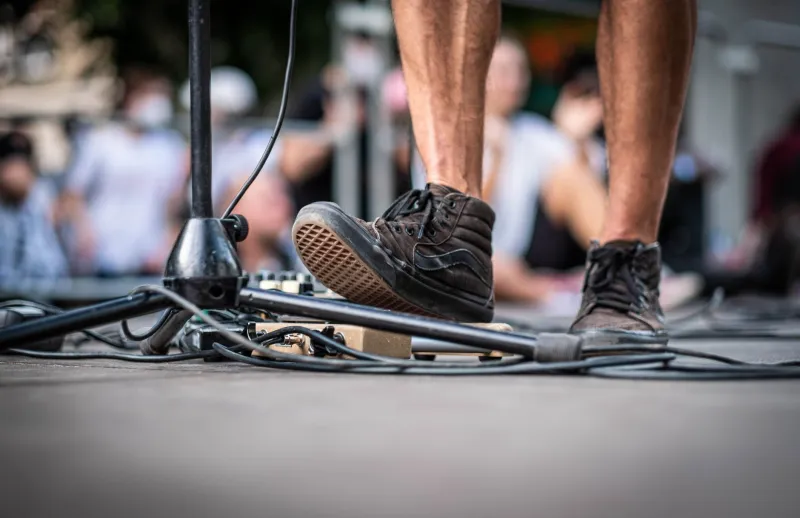
It is 22:41 on a wet Tuesday in a pub back room in Leeds. The four-piece on stage have just hit the final chorus of their best song. The singer says, 'Cheers, we've been Static Orchard,' while the guitarist is already kneeling by the pedalboard, unplugging something that pops through the PA. The drummer is trying to find a lost stick. The bassist is halfway to the bar. Nobody has thanked the sound engineer. The set has ended, but it has not landed.
Grassroots guitar bands spend hours on the first fifteen seconds. They rehearse the count-in, the drop, the pedal click, the way the riff arrives. Quite right too. But the last thirty seconds of a set often gets a shrug and a 'we'll wing it'. That is a strange gap in the rehearsal plan. The ending is the handshake. It is what the room is still holding when it decides whether to buy a record, say hello at the merch table, or catch the 23:12.
The last chord is not the end
A set ending is not one event. It is a small sequence: the final chord, the decay, the feedback if you want it, the amp standby, the thank-you, the walk-off. Each one is a beat. If you do not arrange them, they overlap into a mild panic. The chord rings while someone asks the drummer a question. The feedback starts to swell while the singer is saying goodnight. The amp gets switched off before the last note has finished breathing.
None of this is a catastrophe. It is just a missed opportunity. In a small room, the audience is close enough to see the seams. A planned ending gives them a clear signal: that was the set, you can relax, you can come and say hello. It also gives the next band a clean stage. Both of those things matter more than a perfectly executed tap-tempo delay.
Small rooms have short memories
A 60-capacity back room above a pub in Bristol does not come with a lighting cue. The house lights, such as they are, tend to be the bar lights coming up because someone has started stacking glasses. There is no dramatic blackout. There is a bloke in a waterproof coat looking at his watch. That is the real architecture of the ending.
If you leave the final thirty seconds to chance, the room has to guess what is happening. Is the feedback intentional? Is the band coming back for one more? Is the singer saying something important or just checking the setlist? The audience should not have to do that admin. A deliberate ending is a courtesy. It says: we know you have a last train, a babysitter, a pint waiting. We are going to finish properly.
The shared backline handover
If you are using borrowed amps, the ending is also a handover. You are not just leaving a stage; you are leaving a piece of shared kit for the next band. Decide who mutes, who lowers the master, who switches off, who coils the cables. Do not walk off with the house amp still on standby and the channels dimed. Leave it as you found it, or better.
This is the backline commons in action. The next band are probably loading in while you are packing up. Your last thirty seconds affects their first thirty. Thank the sound engineer by name if you know it. If you do not know it, ask. It is a small thing. It is also the difference between a scene that functions and a scene that grumbles.
The audience is deciding
At 23:00 on a Thursday, an audience is not a single organism. It is a collection of people with different last trains. Some are deciding whether to buy the seven-inch. Some are deciding whether to stay for the headliner. Some are deciding whether to have one more pint or call it. A clear ending helps them choose.
This is not a sales pitch. It is a signpost. A final chord that rings, a nod, a clear thank-you, a mention that there is merch at the back and a walk-off that does not involve tripping over a monitor wedge. That is enough. The merch table is part of the exit, not an afterthought. But it only works if the ending has told the room that the set is actually over.
Rehearse it like a riff
In the practice room, run the last thirty seconds. Set a timer. Play the final song, then practise the ending exactly as you want it. Do it three times. Record it on your phone. Listen back. Is the thank-you audible? Is the feedback too loud? Does the amp get switched off before the last chord has decayed? Are the cables coiled rather than wrapped around your elbow? Does someone thank the sound engineer?
Then practise from the last chorus into the ending, so it is not disconnected. The ending should feel like part of the song, not a separate administrative task. If you want a long feedback drift, rehearse the long feedback drift. If you want a tight stop, rehearse the tight stop. If you want silence, rehearse the silence. Do not leave the most emotionally charged half-minute of the night to muscle memory and hope.
The silence after
The best endings leave a small pocket of silence. Not dead air, but a held breath. That silence is part of the set. It lets the room applaud, or not. It lets the last chord fade. It gives the next band a clean stage. It is also a courtesy to the audience who are putting on coats and checking the time.
In 2026, the UK grassroots circuit is still full of rooms that ask a lot of guitar bands: short changeovers, shared backline, late trains, early load-ins. A rehearsed ending is a small act of respect for all of that. The house lights are not an interruption. They are part of the arrangement. Practise the last thirty seconds and you practise the whole reason you are in the room.