The First Song Starts in the Car Park: Changeover Craft at Grassroots Gigs

Photo: Acabashi, CC BY-SA 4.0, via Wikimedia Commons
There is a moment, roughly twelve minutes before a grassroots guitar band plays, when the room decides something about you. It is not the first chord. It is the sight of four people carrying a bass cab through a door marked Staff Only, apologising to a landlord, and trying to find a plug socket behind a radiator. The changeover is not the warm-up. It is the first part of the set, and small UK rooms are unusually good at reading it.
A twelve-minute changeover is not a test of how fast you can coil a cable. It is a test of whether you have thought about the room before you walked into it. The bands who make it look easy are rarely the ones with the most expensive gear. They are the ones who have rehearsed the boring bits.
The Door Is Part of the Instrument
Every venue has a wrong door. Often it is the one that looks like the right door. The band that arrives at 7:40 with a plan — who is carrying what, where the van is parked, which entrance the landlord actually wants used — is already playing a different gig to the band that arrives at 8:55 with a hatchback full of unlabelled boxes.
Load-in is a physical warm-up, so treat it like one. One trip where two will do is usually a mistake. A bass cab carried through a crowded bar at eye level is not a statement; it is a hazard. If the room is upstairs, pace it. If the door is narrow, take the pedalboard off the top of the amp before you squeeze. These are not glamorous details, but they are the difference between a band that looks in control and a band that looks surprised by its own equipment.
And speak to the person in charge. In a pub back room in Leeds or a community centre in Cardiff, the person who books the night is often also the person who knows where the spare fuse box is. A quick 'we are the second band, where should we put the cases?' saves more time than any amount of silent efficiency.
Tune Quietly, Power Up in Order
The changeover is loud by default. Cases bang, stands clatter, someone always tests a delay pedal at the exact moment the previous band's last song is still ringing in the room. You cannot eliminate noise, but you can decide which noise you make.
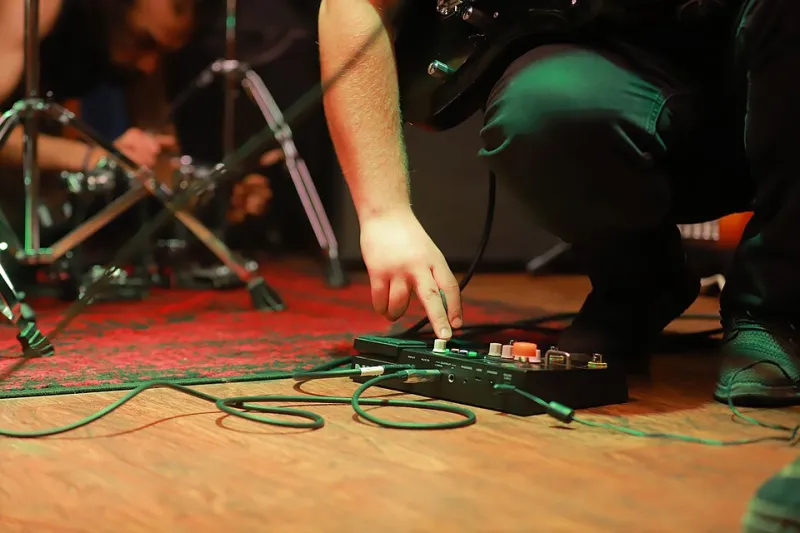
Tune with the amp off or the volume down. If you need a tuner, use a pedal tuner with a mute, and use it before you make eye contact with the sound engineer. Sort power in a fixed order: pedalboard first, then amp, then anything that needs a DI. If your board has a power supply that hums when the lights are on the same circuit, find that out now, not during the first song. Label the wall wart. Know which cable is the spare.
This is also the moment to place the amp for the room rather than for your knees. In a small UK room, an amp tilted back at your calves is a guitar amp aimed at the front row's shins. Put it where you can hear it without turning it up. If the room is shallow and wide, point it across the stage rather than straight out. If the desk has a mic on it, let the engineer do the work. The changeover is not the time to discover that your favourite setting is the one that makes the vocal mic feedback.
The Clock Is a Band Member
The twelve minutes are not a suggestion. They are a structure. Decide before you leave the house which song is your cold-start song — the one that works without a long intro, without a pedal dance, without a tuning break. Decide which song gets cut if the clock runs late. Decide who tunes when, and who talks to the desk.
The most common changeover mistake is not technical. It is a band trying to soundcheck a set instead of starting one. You do not need to hear every pedal. You need to hear the vocal, the guitar, the bass and the snare, in that order, and then you need to stop. If the room is behind schedule, cut the new song. Cut the slow one. Cut the one with the capo and the retune. Keep the songs that make the room turn around.
A useful rule for grassroots nights: the first song should be the one that needs the least explanation. No long intro tape, no atmospheric build, no 'this one is called...' before anyone has decided to listen. Start with the riff that does the work. The room will give you more time once you have given it a reason.
Leave It Better Than You Found It
Strike is part of the changeover too. The band after you is having the same night you are. Coil your cables, take your gaffer tape off the stage, thank the person on the desk, and do not leave a pint glass on top of a monitor wedge. The grassroots circuit runs on favours and memory. The band that leaves a tidy stage is the band that gets asked back.
None of this is rock and roll in the poster sense. It is something better: the quiet craft of making a room ready for a song. The first note is only the first note. The set starts when you carry the amp through the wrong door and decide to be good at it.