Who the Guitar Reaches: Amp Height and the View From the Back of a Small UK Room
Photo: Carol Rose, CC BY-SA 2.0, via Wikimedia Commons
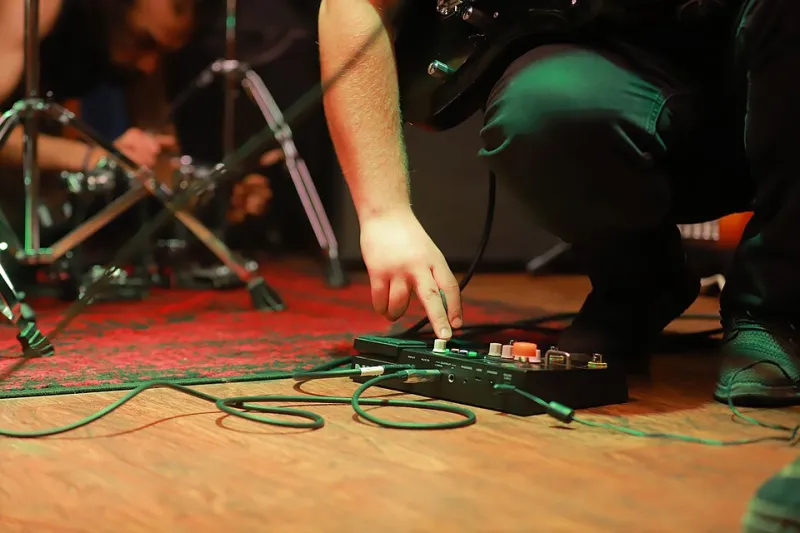
On a wet Tuesday in a function room above a pub, the guitar disappears somewhere around the third row. Up front, someone gets the full beam of a combo sitting on the floor. Further back, behind a pillar and a stack of spare chairs, you can hear the cymbals, the kick drum and a vague idea of a riff. It is not a sound engineering mystery. It is a geometry problem, and the amp stand is right in the middle of it.
The Floor Is a Filter
A guitar amp on the floor is not neutral. It couples with the stage, it fires into shins and it sends its brightest, most directional content at whoever is closest. In a small UK room, that often means the first two rows get the detail and everyone else gets a blur. The people by the bar hear a rumble. The people at the back hear the room. The people near the door hear the till.
Raising an amp changes that distribution. A stand or a sturdy crate lifts the speaker away from the floor and gets the cone closer to seated ear height. Suddenly the guitar has a chance to travel. It is not about making the band louder. It is about making the guitar legible to more than the front row.
A Stand Is a Trade-Off, Not a Solution
The obvious fix creates a new problem. Put an amp on a tall stand in the middle of a shallow stage and you have improved the sound for some people while blocking the view for others. In rooms where the stage is barely a stage, the tallest object wins the sightline. If that object is a 2x12 on a flight case, the audience may hear the guitar and lose the drummer.
So the useful question is not simply how high, but where and at what angle. A side-stage position, angled slightly across the band rather than straight into the audience, can keep the guitar in the mix without turning the amp into a barrier. A modest tilt back can aim the speaker at heads rather than knees. A crate of 30 or 40 centimetres is often enough. The goal is not a museum piece on a plinth. The goal is a guitar that reaches the room without taking over the room.
Low Ceilings Make Every Angle Loud
Low ceilings are a fact of grassroots life. Upstairs rooms, back bars, working men's clubs and converted function spaces were not designed for guitar bands. They reflect high frequencies, compress the low end and make every angle feel more extreme. An amp pointing at a nearby ceiling can sound bright and splashy in one spot and muddy in another.
This is where small adjustments matter. Keep the amp away from a corner if you can. Pull it forward from the back wall. Angle it across the stage instead of into the parallel wall. If the room is very live, a beam blocker or a strip of gaffer tape across part of the grille can take the edge off without killing the punch. None of this is glamorous. All of it is the difference between a guitar-led night and a night where the guitar is a rumour.
Sightlines Are Part of the Mix
A small-room gig is watched as much as it is heard. If the audience cannot see the guitarist's hands, the pedalboard or the singer's face, the performance loses a layer. Amp height has to be considered alongside the rest of the stage picture: the drum kit, the monitors, the merch table, the cable run, the pillar that has been in the same place since 1974.
Clear sightlines are a shared responsibility. Bands can keep amps to the side rather than the centre. They can avoid stacking cases into a wall in front of the stage. Venues can think about where the audience actually stands, not just where the stage fits. A room that only works for the tallest people at the front is not a scene. It is a scrum with a PA.
Who Gets to Hear the Guitar?
This is the quiet politics of the amp stand. A guitar that only reaches the front row is a guitar that has chosen its audience. It favours the tall, the early, the mobile and the confident. It leaves out the shorter listener, the seated regular, the wheelchair user at the side and the person who came straight from work and arrived after the first song.
Raising and angling an amp will not solve every access problem in a grassroots venue. It will not fix a bad PA or a room with no step-free route. But it is one of the few decisions a band can make in ten minutes that widens the circle slightly. It says the guitar is for the room, not just the pit.
A Small-Room Checklist
Start with the amp off the floor, but keep the top of the cab below the eye line of a seated audience where possible. Tilt it back a little rather than straight at the back wall. Put it to one side of the stage so it does not block the drummer or the singer. Check the sound from the back, the sides and the bar, not just from the spot where the guitarist stands. Mark the floor with tape if the stand is unstable. Ask the venue where people naturally stand and where the pillars are. Then make the smallest change that lets the guitar travel further.
The amp stand is not the most romantic object in the van. It is a piece of metal or wood that usually gets forgotten. But in a small UK room in 2026, it is also a small decision about who gets to hear the band. The guitar can still be loud, close and physical. It just does not have to be reserved for the first six people who got there early.