Pinned, Torn, Remembered: What a Venue Noticeboard Knows About a Guitar Scene

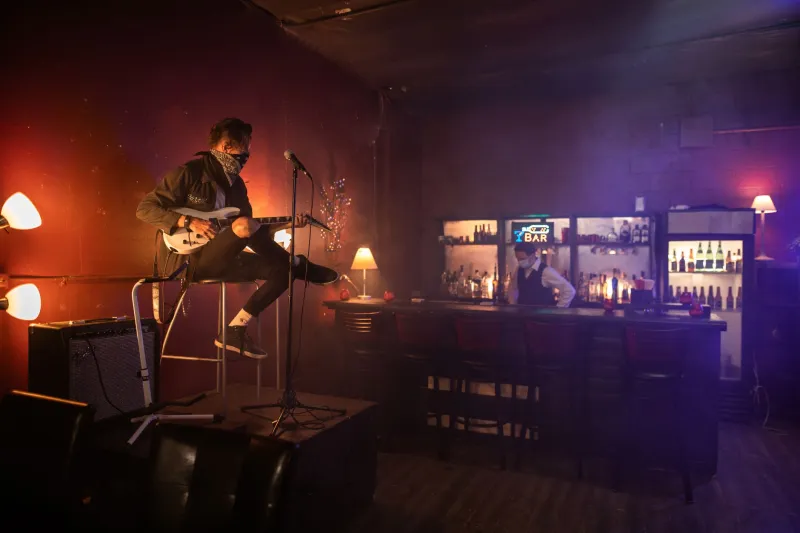
Photo: Jackswain88 (Jack Swain), GFDL 1.3, via Wikimedia Commons
There is a particular smell to a venue cloakroom: damp coats, cheap lager, and the faintly sweet dust of old paper. Above the coat rail, or beside the fire door, or half-hidden behind a stack of folded tables, there is usually a noticeboard. It is not curated. It is not optimised. It is a cork rectangle doing unpaid emotional labour for the local guitar scene.
The board is where flyers go to be layered. A new gig poster goes up on a Tuesday; by Friday it is half-covered by a benefit night in a different town, a handwritten ad for a drummer, and a laminated set-times sheet from a show that finished three weeks ago. The pins go in at angles. The corners curl. Somebody has corrected a typo in biro. Somebody else has drawn a moustache on the support act. This is not a archive in any formal sense. It is something better and worse: a record kept by accident.
The Board as a Stratigraphy of Small Rooms
Archaeologists talk about stratigraphy — layers of soil, each one telling you what happened above it. A venue noticeboard works the same way. The bottom layer is the oldest paper, usually a faded A3 for a weekend all-dayer that promised six bands and a barbecue. The middle layer is the busy season: tours, EP launches, charity nights, a guitar shop advertising a setup clinic. The top layer is whatever happened last week and is already curling at the edges.
What makes it interesting is that nobody edits it. Online, a gig listing disappears when the event passes. The feed moves on. The noticeboard, by contrast, accumulates. A flyer for a band that split up in 2023 might still be pinned under a poster for a show in 2026. The paper outlives the lineup. That is not inefficiency. That is memory.
In one room I visited — a back bar off a ring road in Leeds, the kind of place with a stage the size of a dining table — the board was dominated by a hand-drawn poster for a three-band bill. The ink had bled in the damp. Somebody had written 'SOLD OUT' across it in marker, then crossed that out and written 'not sold out, just busy' underneath. You do not get that on a ticketing platform. You get a green tick and a number. The board gave you the human correction.
What Survives, What Gets Covered
Not everything survives equally. The flyers that last tend to be the ones with the most physical presence: thick card, bold lettering, a decent drawing. A5 photocopies on cheap paper disappear under a single new layer. The board has its own hierarchy, and it is not based on merit. It is based on staple strength and the luck of the draw.
This means the accidental archive is biased. The bands who could afford proper printing get remembered longer. The bands who knocked out twenty photocopies at the library get covered by the next week's noise. But that bias is also honest. It tells you something about the economics of a scene — who had a friend with a risograph, who was willing to spend a tenner on paper, who was just trying to get bodies through the door.
There is also the matter of handwriting. A printed flyer is a broadcast. A handwritten correction is a conversation. On a board in Glasgow, I found a poster for a guitar-led night with a printed lineup and a biro note in the corner: 'support changed — new band on first, doors still 7:30'. Somebody had made that correction because the paper was already up and the information had changed. That little note is more useful to a local historian than the original print. It says: this scene is small enough that we can fix things by hand.
Across Towns, the Same Instinct
The details change from town to town, but the instinct does not. In Bristol, the board was behind the bar, next to a fridge full of unknown lagers. It was mostly local: a guitar shop's setup offer, a call for a bassist, a poster for a shoegaze night with a hand-drawn amp. In Norwich, the board lived in the corridor by the toilets, and the dominant layer was support-slot flyers — bands advertising themselves for any bill going. In Sheffield, somebody had pinned a setlist from a show the previous month, with a note at the bottom: 'thanks for staying'.
That last one stuck with me. A setlist is not a flyer. It is not meant to be public. But it ended up on the board because somebody thought it was worth keeping. That is the whole thing in miniature: the board is where the scene puts things it cannot quite throw away. It is a holding pen for evidence.
The Digital Gap and the Paper Proof
In 2026, most gig information lives in a feed. It is searchable, shareable and instantly disposable. That is fine. But the noticeboard does something the feed cannot: it makes the scene physical. You have to stand in front of it. You have to read it at an angle, under a bad light, while somebody squeezes past with a coat. The friction is the point.
It also creates a different kind of proof. A digital listing can be edited silently. A pinned flyer cannot. If a band's name is on that board, they were there. If a date is crossed out in biro, the change happened in the room. For a grassroots guitar scene that often feels ephemeral — a good night, a bad soundcheck, a support slot that went well — the board is a small, stubborn record.
Why It Matters
None of this is nostalgia for its own sake. The noticeboard is not better than a well-run listings page. It is just different. It remembers things the internet forgets: the wrong spelling, the late change, the band that played first and then split. It remembers the texture of a scene rather than its headline.
So next time you are in a small UK venue, waiting for a guitar band to finish loading in, have a look at the board. Read the layers. Notice what has been covered and what has survived. It is not an official history. It is a pinned, torn, handwritten one — and for a scene built on small rooms and loud amps, that might be the most honest archive we have.