Reverb, Repeat, Reflect: Seven Pedalboard Recipes for the Overthinking Guitarist
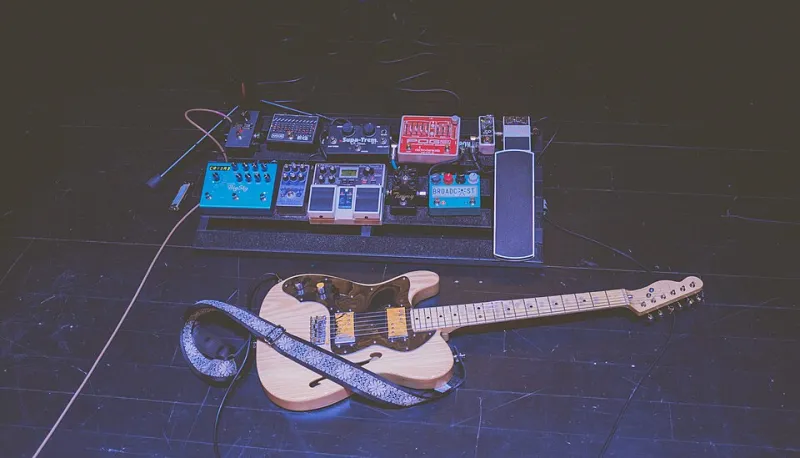
Photo: Unknown authorUnknown author, CC0, via Wikimedia Commons
There is a particular kind of guitar sound that arrives when your head will not switch off. It is not always quiet. It is not always pretty. But it usually has space in it: a delay that repeats before you are ready, a reverb that hangs around like a thought you cannot quite finish, a loop that keeps going while you work out what to play over it. In 2026, UK guitar bands are still finding new ways to make that feeling physical. This is a field guide, not a prescription. A pedalboard is not a cure for an overactive brain. But it is a good place to put the noise.
1. The end-of-the-pier plate
Start with a plate reverb, long decay, mix around 40 per cent, pre-delay short enough to keep the attack. Play single notes and let them ring. The aim is not stadium ambience. It is the feeling of standing at the end of a Brighton pier in February, with the sea doing its own thing and the arcade noise behind you. Boss RV-6 and EHX Oceans 11 both do this without fuss. Keep the amp just on the edge of breakup so the reverb has something gritty to hold on to. Listen to Slowdive's 'When the Sun Hits' for the way a clean guitar can sound enormous without sounding crowded. Note for players: if the reverb is doing all the work, the part is probably too simple. That is not always bad, but know which one you are doing.
2. The dotted-eighth anchor
A low-mix dotted-eighth delay is one of the most useful sounds in introspective guitar music. It gives the player a pulse without a metronome. Set the feedback low, the mix lower than you think, and use it on a clean or slightly broken-up tone. TC Electronic Flashback and Boss DD-8 are common for a reason. The point is not to sound like a U2 tribute. The point is to create a small rhythmic hook that keeps the song moving while the chords stay still. Listen to Radiohead's 'How to Disappear Completely' for the way repetition can feel like a trap and a comfort at the same time. Note for players: if you can hear every repeat clearly, turn the mix down. The delay should be felt before it is noticed.
3. The loop that leaves a gap
Loop pedals are everywhere, but the best uses are often the least showy. Record a short phrase, four to eight seconds, and then leave a gap before you play over it. That gap is the whole trick. It makes the loop sound like a room rather than a backing track. EHX 720 and TC Ditto are good starting points. Listen to Talk Talk's 'New Grass' for the way space can be more dramatic than a crescendo. Note for players: do not fill every bar. If the loop is busy, the audience has nothing to lean into. Also, check your loop level in the room, not just in your headphones. A loop that sounds warm at home can sound like a fridge in a small venue.
4. The shimmer that is not sickly
Shimmer reverb has a reputation problem. Used badly, it sounds like a film score for a mobile phone advert. Used well, it adds an octave-up glow that makes a single note feel like a chord. Walrus Slo and Strymon NightSky can get you there. Keep the shimmer low in the mix and use a high-pass filter if you have one. The aim is texture, not sparkle. Listen to Mogwai's 'Take Me Somewhere Nice' for the way a guitar can sound both heavy and weightless. Note for players: shimmer is a seasoning. If it is the main ingredient, the dish is probably too sweet.
5. The granular ghost
Granular pedals like Chase Bliss Mood and Red Panda Particle are not for everyone. They can turn a guitar into a stuttering, half-remembered phrase. That is the point. Use them as a texture behind a clean part rather than a lead voice. Set the grain size small, the mix moderate, and the modulation slow. Listen to Bark Psychosis's 'Absent Friend' for the way guitar can sound like a memory of itself. Note for players: these pedals reward restraint. If you twist every knob, you are not creating atmosphere. You are creating weather.
6. The fuzz blanket
Not every introspective guitar sound is clean. Sometimes the head will not switch off and the only answer is a wall of fuzz. A Big Muff or an op-amp fuzz into a slightly dirty amp can be a blanket. Roll the guitar volume down for the verse and let it bloom for the chorus. Listen to My Bloody Valentine's 'Sometimes' for the way distortion can feel tender rather than aggressive. Note for players: fuzz is loud. In a small UK venue, a little goes a long way. If the sound engineer is frowning, they are probably right.
7. The one-chord tremolo meditation
You do not need a pedalboard for this one. Amp tremolo, a volume pedal, or even just your guitar's volume knob can do it. Pick one chord and let it repeat until it stops being a chord and starts being a pulse. This is where the slow-burn bands in small rooms earn their keep. Listen to Yndi Halda's 'Illuminate My Heart, My Darling!' for the way repetition can build without adding more notes. Note for players: dynamics are the effect. If you play the same chord at the same volume for five minutes, you are not meditating. You are waiting.
A pedalboard is not a personality
It is worth saying plainly: you cannot buy a mood. The best guitar tones in UK underground music come from players who know what they want a room to feel like, then choose the tools to get there. That might mean a second-hand Boss pedal from a shop on Denmark Street, a kit from a UK builder, or a boutique pedal you have saved for months to afford. It might also mean playing less. A reverb cannot fix a song with no idea. A delay cannot make a part interesting if the part was not interesting to begin with.
If you are building a board for introspective sounds, start with one good reverb, one delay you understand, and a tuner. Add the loop pedal when you have something to loop. Add the granular pedal when you have a reason to sound like a ghost. And check your power supply. Noise is not atmosphere. It is just noise. In 2026, there are more ways than ever to make a guitar sound like a thought. The trick is still knowing which thought you are trying to have.