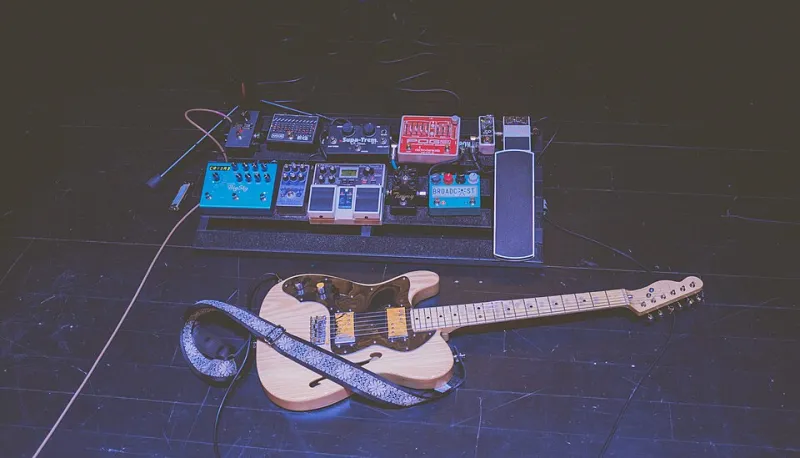
The First Band Are Doing the Heavy Lifting: Grassroots Stages and the Art of the Slow Burn in 2026

Photo: TM4Downsyndrome, CC BY-SA 4.0, via Wikimedia Commons
At 7:45 on a wet Tuesday in Sheffield, the room is maybe a third full. The headliner's backdrop is still rolled up in a corner. A guitarist is tuning pedals that cost more than the night's fuel. Then the first band start with one note, held long enough that a few people look up from their phones. That is the moment this piece is about. In 2026, the most interesting stuff in UK guitar music is not always happening at 9:30 with the lights down and the merch queue forming. Often it is happening at 7:45, in a small room, with a band who have twenty minutes and no obligation to pretend they are a greatest-hits act.
The room before the room fills
Support slots have always been a slog and a privilege at the same time. You get a fraction of the soundcheck, a fraction of the audience and a fraction of the attention. But you also get a room that has not yet hardened into a crowd. People are still arriving. The bar queue is short. The front row is close enough to hear the strings. In 2026, with touring costs still biting and grassroots venues under constant pressure, that early slot has become something more useful than a warm-up. It is a laboratory.
Bands can test the slow stuff there. The two-minute intro. The song that does not reach a chorus until the fourth minute. The new material that might not survive a Friday night in a bigger venue where the bar is louder than the band. The support set is short enough to be honest. There is no encore to protect, no reputation to defend, no expectation to play the one song people know from a playlist. That freedom is worth something.
Five rooms where the quiet gets a hearing
At The Windmill in Brixton, the floor is sticky, the ceiling is low and the stage is barely a stage. It is the kind of room where a band can play a single sustained note and let the hum of the fridge become part of the arrangement. Acts like Mosslight use that. Their opening set is less a set of songs than a set of rooms within songs: a clean arpeggio, a long pause, a burst of feedback that arrives late enough to feel like a decision rather than a habit. The Windmill has seen plenty of noisy nights, but the early slot is where you notice how much can happen when nobody is shouting for a hit.
At The Hope & Ruin in Brighton, the sea air does not make it any less sticky. The room has a habit of making guitar music sound slightly isolated, which suits bands like Harrower. They open with a loop pedal, a hollowbody guitar and a drummer using brushes. It is not ambient wallpaper. There are songs in there, just ones that unfold slowly and ask the audience to lean in. Brighton has no shortage of bands chasing a big chorus. The interesting ones are often the ones using the support slot to see if a small idea can hold a room without a light show.
Gullivers in Manchester is another good test. The back room is close, the sound is direct and the audience is near enough to notice when a guitarist changes from fingers to a pick. The Quiet Hours have used that setup to try unfinished songs, the sort that arrive with a working title and a slightly apologetic introduction. That is not a weakness. It is how material gets better. A support slot is one of the few places where a band can play something new twice in a month and hear what changes. The room tells you quickly whether the quiet parts are working or whether they are just long.
In Glasgow, The Hug & Pint has a basement feel that makes every amp seem louder and every silence seem more deliberate. Low Tide Choir use that. They are a three-piece who can make a single chord sound like a conversation, with a reverb tail that hangs around long enough to fill the gaps. The early audience is often smaller, but it is also more curious. People have come out on a weeknight. They are not there by accident. That matters.
And at Sidney & Matilda in Sheffield, the industrial edges of the room do something to guitar music. Static Orchard have used the space to try a set of slow-burn instrumentals, the kind that build through repetition rather than a big riff. The room is not a cathedral. It is a working venue with a bar and a door that lets in cold air. But that is exactly why the quiet can land. It has to compete with the real world, not a staged version of it.
Why twenty minutes suits the slow burn
A twenty-minute set is a short story, not a novel. It cannot rely on the slow build of a full headline show. It has to make a decision quickly: what is this, and why should you stay? That pressure can be good for guitar bands. It strips away the padding. It forces a choice between atmosphere and noodling. The best opening sets often feel like one idea followed through, rather than five ideas apologising for each other.
The slow-burn material also suits the room. In a small venue, the audience is close enough to hear the mechanics of a guitar: the pick against the string, the click of a pedal, the breath before a phrase. That is not a nostalgic detail. It is the whole point. Streaming rewards the first five seconds. A live room rewards patience, but only if the band gives the audience something to be patient with. The support slot is where that bargain is tested every night.
There is also a practical reason why the quietest moments often matter more than the headline hype. Headline sets are built to satisfy. They have to deliver the songs people came for. Support sets are allowed to be stranger. They can be too slow, too sparse, too long in the middle. They can fail in public. That is how a scene stays alive. The underground is not just a farm system for bigger stages. It is a thinking space.
The risk of getting misty-eyed about it
It would be easy to romanticise all of this. Not every support slot is sacred. Plenty are ignored. Plenty happen in rooms where the PA is held together with tape and the audience is more interested in the pub next door. Bands can mistake slow for deep. Promoters can stack three quiet acts on a bill and wonder why nobody is listening. The quiet only works if the room is set up for it.
That means venues have a role beyond providing a stage. It means putting bills together with care, giving early acts a decent soundcheck, and not treating the first band as background music for the door. It also means audiences have a role. Go early. Stay curious. Put the phone away for twenty minutes. You do not have to love everything. But you might hear the moment a band works out what they are.
Go early, stay curious
The main event will always be the headline. That is how bills work. But in 2026, the most alive part of UK guitar music is often the part that has not been hyped yet. It is the first band, the half-full room, the song that takes its time. The support slot is not the main event in terms of ticket sales. It is the main event in terms of what happens next. Go early. The thinking space is already open.